


News – Events – Calls
| 02. May 2024 18:30 Simon Wiesenthal LectureEdyta Gawron: Never Too Late to Remember, Never Too Late for Justice! Holocaust Research and Commemoration in Contemporary PolandIn 1994, Simon Wiesenthal received a doctorate honoris causa from the Jagiellonian University in Krakow for his lifelong quest for justice – half a century after he had been, for a short time, prisoner of the local Nazi Concentration Camp (KL) Plaszow. The 1990s were the decade when t...Weiterlesen... |
| 07. May 2024 00:00 - 04. June 2024 00:00 WorkshopDealing with Antisemitism in the Past and Present. Scientific Organisations and the State of Research in AustriaThis series of talks, presented by antisemitism experts from different organisations that research antisemitism using a variety of academic approaches, aims to provide a snapshot of historical evolutions, current events, prevalent perceptions and declared (and undeclared) attitudes. I...Weiterlesen... |
| 14. May 2024 08:45 - 16. May 2024 16:30 TagungQuantifying the Holocaust. Classifying, Counting, Modeling: What Contribution to Holocaust History? About the conference: https://quantiholocaust.sciencesconf.org/ Programme timed on the basis of 15-minute presentations + 15-minute discussions; short breaks and lunches Day 1 Tuesday, 14 May 2024Centre Malher (9 rue Malher 75004 Paris/amphi Dupuis) From 8.45 am: Welcome9.30 am...Weiterlesen... |
| 24. May 2024 18:00 InterventionLange Nacht der Forschung 20242024 öffnet das Wiener Wiesenthal Institut für Holocaust-Studien (VWI) in der Langen Nacht der Forschung wieder seine Tore und lädt Interessierte in seine Räumlichkeiten am Rabensteig 3 ein. Im Rahmen von Vorträgen, Podiumsdiskussionen und Präsentationen bieten VWI-Team und Gäste Einb...Weiterlesen... |
| 04. June 2024 13:00 VWI invites/goes to...Workshop: Social History of the Shoah. Everyday Life, Space and Time VWI invites the Department of Contemporary History, University of Vienna 13:00Hannah Riedler (VWI Junior Fellow)Between Deportation, Forced Labour and Germanisation. The Umwandererzentralstelle in Occupied Poland 1939–1941Commented by Kerstin von Lingen 13:40...Weiterlesen... |
| 13. June 2024 18:30 Simon Wiesenthal LectureJack Fairweather: The Trials of Fritz Bauer. How Life as a Gay Jewish Socialist under the Nazis Shaped His Quest for JusticeFritz Bauer’s daring mission to bring Adolf Eichmann and the perpetrators of Auschwitz to justice forced Germany and the world to pay attention to the crimes of the Holocaust. Bauer’s moral courage in speaking out in a society that had not yet come to terms with its past, which he him...Weiterlesen... |
Daan de Leeuw
Junior Fellow (10/2023 – 08/2024)
The Geography of Slave Labor: Dutch Jews and the Third Reich, 1942–1945
 This project looks at the movement of Jewish forced labourers through the concentration camp system. The Germans moved the prisoners to wherever the war industry needed them. This kind of forced relocation was ubiquitous, yet it has received little attention from scholars. This interdisciplinary project investigates how Dutch-Jewish forced labourers experienced these frequent relocations. It uses spatial and social history methods and is based on survivors' testimonies and administrative documents. By using geographical information systems and manual cartography to visualise the routes through the camp system, the project opens up a new perspective on both the plight of Dutch Jewish forced labourers and the social dynamics between concentration camp inmates.
Daan de Leeuw, PhD candidate at the Strassler Center for Holocaust and Genocide Studies, Clark University. Yad Vashem Summer Research Fellow, Prince Bernhard Cultural Fund Grant recipient, Fellow at the Center for Holocaust Studies at the Leibniz Institute of Contemporary History, EHRI Conny Kristel Fellow and Ben and Zelda Cohen Fellow at the USHMM.
E-Mail: This email address is being protected from spambots. You need JavaScript enabled to view it.
Vlasta Kordová
Junior Fellow (03/2024 – 08/2024)
Bandenbekämpfung: The Nazi Persecution of Objective Enemies in the Reflection of the “Heydrichiada” and the Slovak National Uprising
 The project examines the methods of fighting partisans used by the German occupiers and their connection to the Holocaust. It conceptualises the term "fighting gangs" used by the Nazis and shows how it became ideologically charged (followed by the concept of "war of extermination"). The theoretical part of the thesis focuses on the earlier development as well as the goals of Nazi "security policy" and its main instrument - the police. The empirical part then applies the results of the theoretical analysis to two examples where the National Socialist security forces had to react to an immediate "threat": the assassination of Reinhard Heydrich in the Protectorate of Bohemia and Moravia in May 1942 and the operation against the Slovak National Uprising in autumn 1944.
Vlasta Kordová, graduate of the Philosophical Faculty and the Faculty of Education at Charles University in Prague, currently a PhD Candidate at the Faculty of Philosophy of the Jan Evangelista Purkynê University in Ústí nad Labem. During her doctoral studies numerous scholarships in Germany and Austria. Author of several articles and two monographs.
E-Mail: This email address is being protected from spambots. You need JavaScript enabled to view it.
Hannah Riedler
Junior Fellow (10/2023 – 08/2024)
Between Deportation, Forced Labour and Germanisation. The Umwanderer Central Office in Occupied Poland 1939-1941
 Immediately after the beginning of the conquest of Poland in 1939, the German occupiers began deporting hundreds of thousands of people from the annexed territories to the Generalgouvernement - Jews and non-Jews alike. The newly founded Umwandererzentralstelle (UWZ) was responsible for coordinating the expulsion as well as the transport of those affected. Many of the UWZ perpetrators later worked alongside Adolf Eichmann on the deportation of Jews. In addition to these personal connections, the project focuses on the daily deportation practice of the UWZ and its coordinating and ideological function in carrying out the immense population displacements.
Hannah Riedler, MA studies with a focus on Eastern European History at the University of Vienna, doctoral student at the University of Klagenfurt. Research interests: Occupied Poland in the Second World War, Holocaust, deportations in Poland in the Soviet and German and German occupation zones.
E-Mail: This email address is being protected from spambots. You need JavaScript enabled to view it.
Mirnes Sokolović
Junior Fellow (10/2023 – 03/2024)
The Construction of Europe by the Yugoslav Literary Right-Wing
 The project is concerned with war propaganda and ideas about Europe in the Yugoslav literary right of the 1930s and 1940s. It focuses on the construction of a right-wing propaganda style and a discriminatory and a discriminatory cultural concept of Europe. The anti-Semitic glossary that helped to remove one of its constituent components from European culture and to construct an "ethnically pure" European culture characterised the mainstream of right-wing propaganda in Serbo-Croatia during the 1930s and 1940s. The project seeks answers to the questions of what led avant-garde writers to radical ideologies, what role intellectuals and the intellectuals and the media in legitimising crime and genocide and what makes the difference between right-wing and liberal international concepts of Europe.
Mirnes Sokolović, MA studies with a focus on in South Slavic literature at the University of Sarajevo. He is a member of the of the founding team and the editorial of the literary magazine SIC! and worked in the cultural departments of E-novina in Belgrad and Oslobođenje in Sarajevo. He has published a novel, two volumes of essays and prose, essays, satire, literary criticism and articles in magazines.
E-Mail: This email address is being protected from spambots. You need JavaScript enabled to view it.
Junior Fellowships 2023/24 at the Vienna Wiesenthal Institute for Holocaust Studies (VWI)
The Vienna Wiesenthal Institute for Holocaust Studies (VWI) invites applications for its junior fellowships for the academic year 2023/24.
The VWI is an academic institution dedicated to the research and documentation of antisemitism, racism, nationalism and the Holocaust. Conceived and established during Simon Wiesenthal’s lifetime, the VWI receives funding from the Austrian Federal Ministry of Education, Science and Research, the Federal Chancellery as well as the City of Vienna. Research at the Institute focuses on the Holocaust in its European context, including its antecedents and its aftermath.
PhD-candidates from anywhere in the world are eligible to apply for a junior fellowship. Junior fellows will be able to work on a research project of their choice in the field of Holocaust studies at the Institute. Beyond the research work itself, the stay at the Institute is intended to encourage communication and scientific exchange among the fellows at the Institute. Junior fellows will receive support and advice from the VWI as well as its senior and research fellows. Junior fellows are expected to regularly attend the VWI and take on an active role in the Institute’s research activities.
Research projects are to focus on a topic relevant to the research interests of the VWI. Within this parameter, applicants are free to choose their own topic, approach, and methodology. Fellows will have access to the archives of the Institute. It is expected that fellows will make use of relevant resources from the collection in their research projects. Research results will be the subject of formal fellows’ discussions and will be presented to the wider public at regular intervals. At the end of their stay, fellows are required to submit a research paper which will be peer-reviewed and published in VWI’s e-journal S:I.M.O.N. – Shoah: Intervention. Methods. Documentation.
Junior fellowships are awarded for a duration of between six and eleven months. Experience tells that residencies between nine and eleven months are the most productive for facilitating the research of the fellows at the VWI. Junior fellows will have a working space at the VWI and Internet access and will receive a monthly stipend of € 1,200. In addition, junior fellows who are not Vienna residents will receive accommodation funding of € 340 per month. VWI will also cover the costs of a round-trip to and from Vienna (coach class airfare or 2nd class train fare). There is an additional one-off payment of € 500 available for research conducted outside of Vienna or photocopying costs outside of the Institute, where applicable.
Junior fellows will be selected by the International Academic Advisory Board of the VWI.
Applications may be submitted in English or German and must include the following documents:
- completed application form,
- a detailed description of the research project, including the objectives, an overview of existing research on the topic and methodology (12,000-character max.),
- two letters of recommendation (please indicate when sent separately),
- list of publications (if applicable),
- a CV (optional: with picture).
Please send your application in electronic format (in one integral *.pdf-file) with the subject header “VWI Junior Fellowships 2023/24” by 13 January 2023 to:
This email address is being protected from spambots. You need JavaScript enabled to view it..
If you do not get confirmation that we have received your proposal, please contact us.
Junior Fellowships 2024/25 at the Vienna Wiesenthal Institute for Holocaust Studies (VWI)
The Vienna Wiesenthal Institute for Holocaust Studies (VWI) invites applications for its junior fel-lowships for the academic year 2024/25.
The VWI is an academic institution dedicated to the research and documentation of antisemi-tism, racism, nationalism and the Holocaust. Conceived and established during Simon Wiesen-thal’s lifetime, the VWI receives funding from the Austrian Federal Ministry of Education, Science and Research, the Federal Chancellery as well as the City of Vienna. Research at the Institute focuses on the Holocaust in its European context, including its antecedents and its aftermath.
PhD-candidates from anywhere in the world are eligible to apply for a junior fellowship. Junior fellows will be able to work on a research project of their choice in the field of Holocaust studies at the Institute. Beyond the research work itself, the stay at the Institute is intended to encour-age communication and scientific exchange among the fellows at the Institute. Junior fellows will receive support and advice from the VWI as well as its senior and research fellows. Junior fellows are expected to regularly attend the VWI and take on an active role in the Institute’s research activities.
Research projects are to focus on a topic relevant to the research interests of the VWI. Within this parameter, applicants are free to choose their own topic, approach, and methodology. Fel-lows will have access to the archives of the Institute. It is expected that fellows will make use of relevant resources from the collection in their research projects. Research results will be the sub-ject of formal fellows’ discussions and will be presented to the wider public at regular intervals. At the end of their stay, fellows are required to submit a research paper which will be peer-reviewed and published in VWI’s e-journal S:I.M.O.N. – Shoah: Intervention. Methods. Documentation.
Junior fellowships are awarded for a duration of between six and eleven months. Experience tells that residencies between nine and eleven months are the most productive for facilitating the research of the fellows at the VWI. Junior fellows will have a working space at the VWI and In-ternet access and will receive a monthly stipend of € 1,400.-. In addition, junior fellows who are not Vienna residents will receive accommodation funding of € 600.- per month. VWI will also cover the costs of a round-trip to and from Vienna (coach class airfare or 2nd class train fare). There is an additional one-off payment of € 200.- available for research conducted outside of Vienna or photocopying costs outside of the Institute, where applicable.
Junior fellows will be selected by the International Academic Advisory Board of the VWI.
Applications may be submitted in English or German and must include the following documents:
- completed application form,
- a detailed description of the research project, including the objectives, an overview of existing research on the topic and methodology (12,000-character max.),
- two letters of recommendation (please indicate when sent separately),
- list of publications (if applicable),
- a CV (optional: with picture).
Please send your application in electronic format (in one integral *.pdf-file) with the subject header “VWI Junior Fellowships 2024/25” by 12 January 2024 to:
This email address is being protected from spambots. You need JavaScript enabled to view it..
If you do not get confirmation that we have received your proposal, please contact us.
Yulia Abibok
Junior Fellow (10/2022 – 08/2023)
Victims, Perpetrators and "Our Guys": Interethnic Relations and Mass Massacres in Eastern Galicia
 The research is focused on Second World war events in the former powiat trembowelski (in the territory of Ternopil region in today's Ukraine). This is an attempt to look at the history of the Second World War from the perspective of members of a relatively small multicultural community. The project aims to establish the general picture of life in 1917-1945 in powiat trembowelski and then to look at the problem at the microlevel by researching and analysing several personal stories of people of Ukrainian, Jewish, and Polish origin from the area to demonstrate the entire complicity of relations during that period, as well as ideas and reasons behind those relations. The general idea of the research is to follow and explain individual choices of perpetrators, lifesavers as well as bystanders made in extreme circumstances which stimulated identity-based groupings and divisions. Bystanders are not regarded as an absolute and single category which is entirely opposite to both perpetrators and saviors.
Yulia Abibok, researcher (Jewish Studies) and journalist, studies Comparative History at the Central European University. Her research interests include territorial and interethnic conflicts in Eastern Europe and the (post-)Soviet space; group identity building and propaganda; social transformations, business relations and organised crime in the 1990s in post-Soviet countries.
E-Mail: This email address is being protected from spambots. You need JavaScript enabled to view it.
Emil Kjerte
Junior Fellow (10/2022 – 07/2023)
Ustaša Killing Specialists: The Personnel of the Jasenovac Concentration Camp Complex
 The dissertation focuses on those men and women who served as guards in the concentration and death camp Jasenovac, the epicentre of state-organised extermination in the fascist Independent State of Croatia. Drawing on records from post-war trials in the Socialist Federal Republic of Yugoslavia and testimonies of survivors, the social backgrounds and motivation of the guards for their voluntary service will be explored. The broad spectrum of violent acts committed by the guards will be analysed.
Drawing on theories on the microdynamics of violence and insights from the historiography of Holocaust perpetrators, the connections between the use of violence and group-internal relationships within the guards will be examined. The focus is on the interplay between violence and identity formation. In addition, the violence against the civilian population in the vicinity of the camp will be analysed and the careers of the Jasenovac perpetrators in the post-war period will be examined.
Emil Kjerte, PhD student at the Strassler Center for Holocaust and Genocide Studies at Clark University. B.A. in History at the University of Copenhagen and M.A. in Holocaust and Genocide Studies at Uppsala University. Fellowships from the Fondation pour la Mémoire de la Shoah in Paris and the United States Holocaust Memorial Museum in Washington.
E-Mai: This email address is being protected from spambots. You need JavaScript enabled to view it.
Lukas Nievoll
Junior Fellow (02/2022-07/2022)
The Violent Order of Space: Spatial Development and Dynamics of Violence at Gusen Concentration Camp
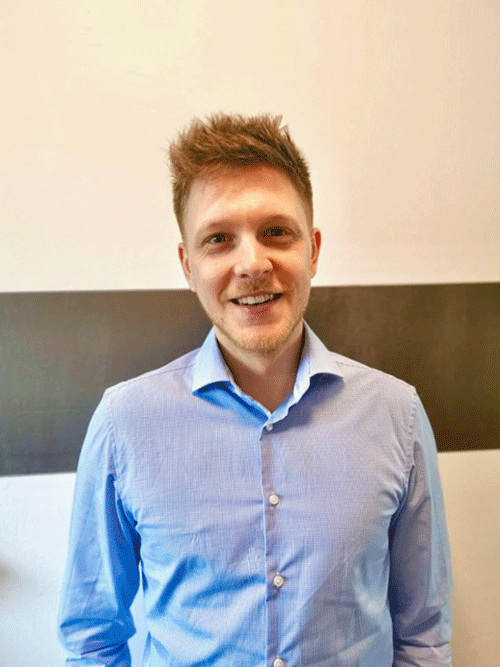 My PhD-project deals with the relationship between space and violence in Nazi concentration camps, using the example of the Gusen concentration camp(s) from 1939 to 1945. I analyze how the spatial structure of the camp was changed over time and how this corresponded with the dynamics of violence. From a bottom-up perspective, I also investigate how prisoners experienced and shaped the changing physical and social reality of the camp.
Lukas Nievoll is a historian and, since October 2021, a university assistant at the Institute for Modern History and Contemporary History at the Johannes Kepler University Linz where he also pursues his Ph.D. Since 2021 he has also been a Doctoral Fellow at the Fondation pour la Mémoire de la Shoah in Paris. Between 2019 and 2021 Lukas Nievoll worked at the Center for Jewish Studies at the Karl Franzens University Graz in the research project Digital Memory Landscape - Persecution and Resistance under National Socialism.
E-Mail: This email address is being protected from spambots. You need JavaScript enabled to view it.
Suzanne Swartz
Junior Fellow (10/2014 - 08/2015)
Hidden Encounters: Interactions among Jewish and Christian Children in Nazi-Occupied Warsaw
 This project examines the illegal, clandestine, and chance interactions among Jewish and Christian children in Nazi-occupied Warsaw. Encounters most frequently came about through some form of resistance to Nazi authority. Contact took place within spaces that children created for themselves, such as smuggling or peddling rings, and within spaces or circumstances constructed or controlled by adults, such as orphanages, convents, or private homes where families hid Jews. Children’s interactions in dangerous situations were often complex combinations of both peaceful and combative, and motivations for assisting each other moved within gray areas of altruism and self-survival. This study examines children’s encounters in wartime spaces and across boundaries, to demonstrate how children moved within and pushed against limitations of Nazi oppression.
Suzanne Swartz is a History PhD candidate at Stony Brook University in New York, where she received her M.A. in 2013. B.A.: Colby College, 2007. Past program participation: German Historical Institute's Archival Seminar, Auschwitz Jewish Center Fellows Program. In 2012 she was a Lipper Intern for Holocaust Education at the Museum of Jewish Heritage. Research interests: children's resistance, Polish-Jewish relations, memory, Holocaust education.
Sari J. Siegel
Junior Fellow (03/2015 - 08/2015)
Between Coercion and Resistance. Jewish Prisoner-Physicians in Nazi-Camps
 The research examines an important yet widely overlooked group in Holocaust history—Jewish inmates who utilized their medical knowledge in Nazi camps. Focusing on the labour, concentration, and extermination camp systems in the Reich between 1938 and 1945, it draws particular attention to the dynamic natures of camp conditions and the prisoner-physicians’ strategies to save their own lives as they attempted to treat fellow inmates and uphold their Hippocratic promise to ‚do no harm.‘ The work combines survivor testimonies and legal documents with contemporary government and organisational records for insight into how contextual variables and individual traits shaped the actions of these doctors in the camps. Since the prisoner-physicians’ medical activities placed them within survivor and memoirist Primo Levi’s ‚gray zone‘, analysis of their behavioral shifts allows to illuminate a new aspect of this morally ambiguous realm.
Sari Siegel is a doctoral student supervised by Prof. Wolf Gruner at the Univ. of Southern California. Born and raised in New York, she received her BA with Distinction in History from Yale Univ. She is the American recipient of the 2014 IfZ-USHMM Exchange of Scholars Award and a 2014-15 Kagan Fellow. She has presented her research at several international conferences, and her article Treating Dr. Maximilian Samuel: A Case Study of an Auschwitz Prisoner-Doctor will appear in a forthcoming issue of Holocaust and Genocide Studies.